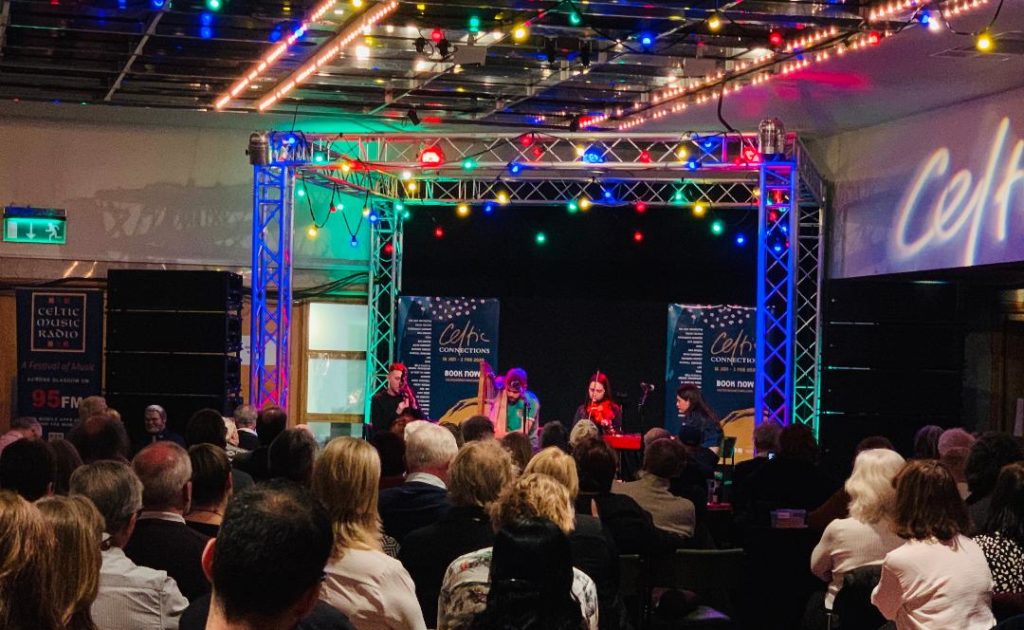
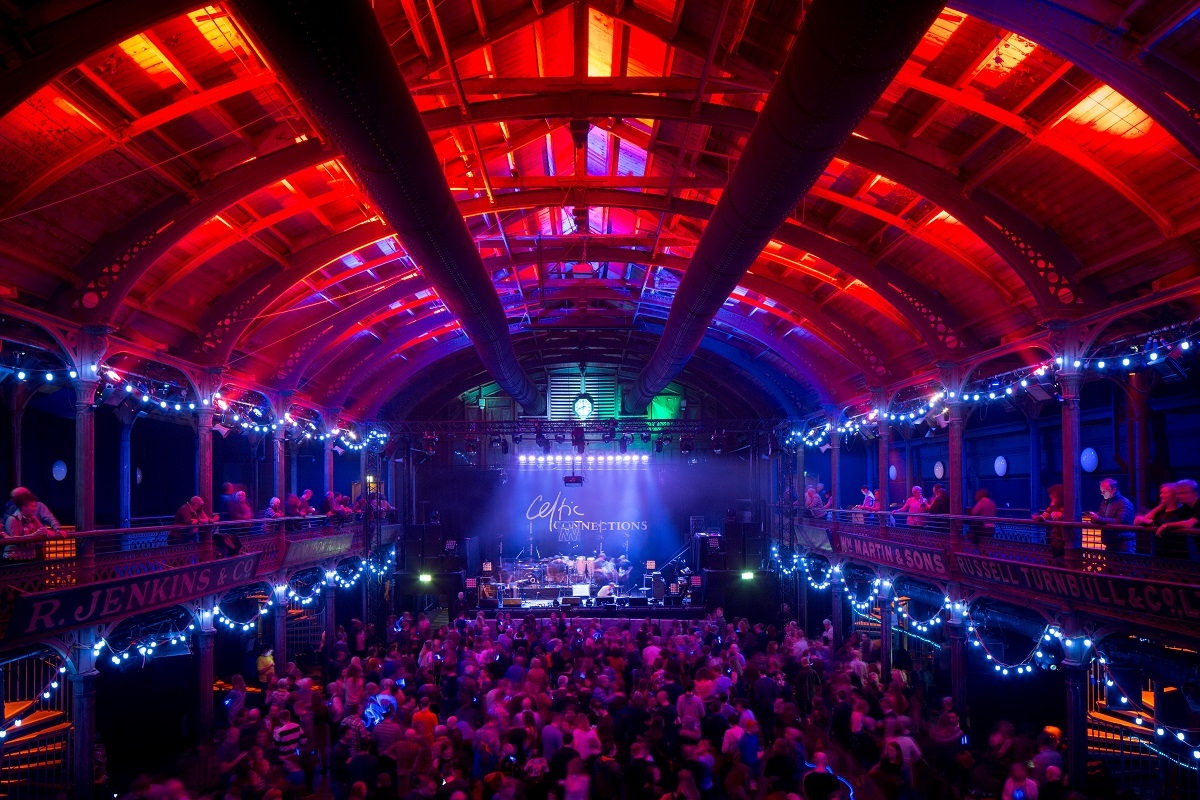
Our Mother Tongue – Celtic Connections – Glasgow Royal Concert Hall – January 22, 2026.
Written by celtic music radio on January 23, 2026
Le Vent Du Nord
Our Mother Tongue was a celebration of language in the trad world with a big cast – hence the lengthy review. Here are the artists in order of performance:
É.T.É: From Québec, É.T.É take their name jointly from the French word for Summer and the initial letters of the names of the players – violinist Élisabeth Moquin, bouzouki player Thierry Clouette and cellist Élisabeth Giroux. Thierry, as seems to be the lot of Quebecois fiddlers also doubles on podorhythmie, the foot percussion that drives so much of Canadian traditional music. They opened with their current single Aronde – an old name for the bird, the swallow. The rhythm was that of a driving, foot-tapping reel but with cross-rhythms that cut across the tempo mirroring the darting flight of the bird. Superb playing. There wasn’t much chat between numbers (they were rushing off to another gig), so went almost straight away into Tarsil from their 2019 album Les Quatre Roses. This gave them a chance to display their vocal skills, swapping back and forth between solo and excellent three-part harmony voices.
MISCHA MACPHERSON: Mischa did a superb job as compère for the evening as well as taking the 2nd spot. For me, Mischa is the finest Gaelic voice of her generation and her opening ballad showed all the melodic beauty that voice is capable of. She followed this with a rousing puirt à beul medley that had every toe in the hall tapping.
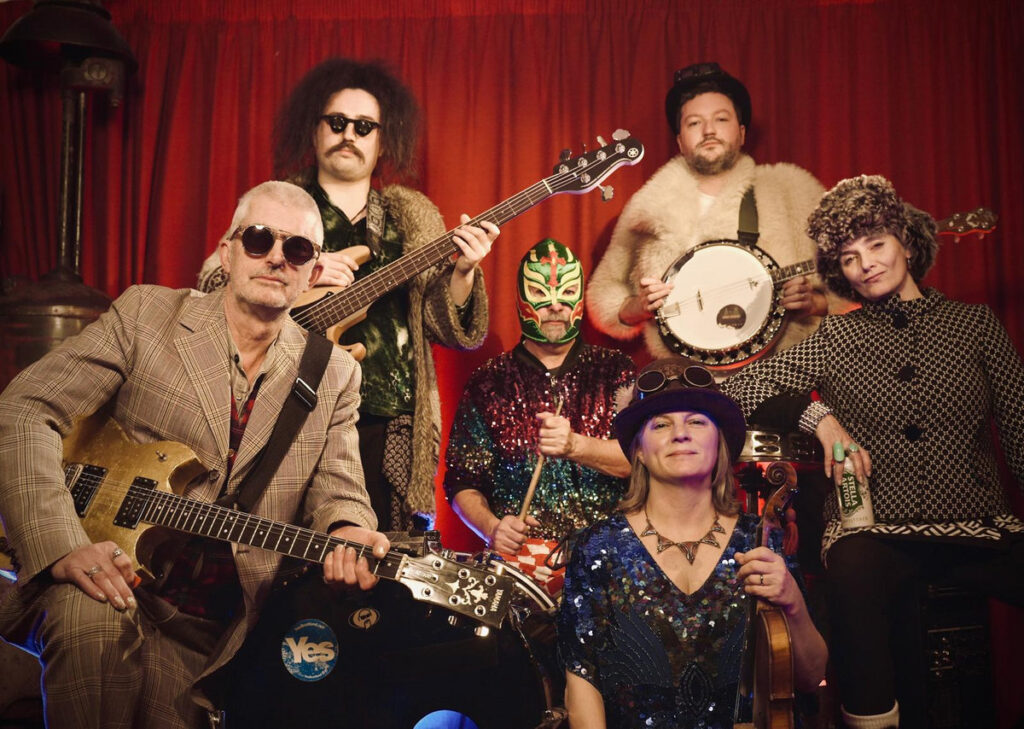
PARULINE: Paruline are a five-piece folk-rock band from Québec named for the Canada Warbler bird – and they certainly warble well. Their three number set featured some fine singing and first-class playing. Their three songs were all from their current album, À ceux qui veillent (To Those Who Watch). Curious about the band, I checked their lyrics page after the gig and found some strange, very poetic writing there. They opened with Immobile – a song of an affair “that must not be mentioned” with the wife of an older man. Very spacy ambiental performance. Stylistically, it swayed back and forth between trad and an almost psychedelic sound. Next was Chiendent, a number about dancing with a beautiful girl who “controls the field like weeds” – an odd image presumably referring to her being irrepressible, and a much more traditional sound. The final song Théophile describes the singer going to meet his lover when a headless man appears and tells him she has drowned. All rather odd, but strangely intriguing. I would describe them as a cross between Genticorum and Pink Floyd. I know, sounds weird, but it works.
GWILYM RHYS TRIO: Gwilym Bowen Rhys sang a pair of what he described as “tree-related” songs. The first, Coed Glyn Cynon or Glyn Cynon Wood was his setting of a 16th century poem cursing English industrialists who cut down the trees to make charcoal. Gwilym’s expressive voice and playing conjured an appropriately moody, almost menacing tone, aptly reflecting the subject matter. He followed that with Si-So Gorniog – described as “a woodsawing shanty”. It translates as “The Horned See-Saw” and refers to a long two-man saw with a handle or ‘horn’ at each end. The rhythm and title seem to make it a sister song to the nursery rhyme See Saw Margery Daw which also originated as a work song for sawyers. Gwilym’s set displayed an excellent voice and a notable sense of humour shown in the between numbers banter. The arrangements too were worthy of mention. Gwen Màiri (harp) and Patrick Rimes (fiddle) provided a marvellous interplay with Gwilym’s excellent guitarwork that splendidly underpinned, but never overpowered, the songs. Thoroughly enjoyable.
PADRAIG JACK: After the interval, Padraig opened with the title track from his 2020 album Making Sand. It’s an absolutely beautiful song about his native Aran Islands, likening the native Irish culture to hard rocks slowly turning into sand. He followed this with These Shores, title track from his 2024 release. It’s a homage to the long historic struggle to preserve the Irish culture he obviously loves so dearly and expresses his hope for the unification of the island. Into this, he twined in a verse of the traditional Amhrán Mhuínse (The Song of Munis), a deathbed song of a woman longing to be buried in her native land. This artist was a wonderful surprise to me. Great songwriting, full of that emotion and poetry that we always claim lives in the Celtic soul.
MACALLA: Macalla, (meaning ‘echo’ in Irish) is a British Council sponsored collaboration bringing together the North West Folk Collective, (NI/IRE) with members of Mshakht Collective (Iraq). As is so often the case, these collaborations tend both to introduce the musicians and audience to music unfamiliar to them but also to hint at ancient roots underpinning different musical traditions. Here I was struck by the way in which the harp in particular melded beautifully with its Iraqui counterpart in the opening number. They also played a wonderful mix of a Kurdish traditional tune with an Irish jig that was obviously a musical marriage made in Heaven. Entertaining, educational, and a joy to listen to.
GRUFF RHYS: Gruff Rhys has a number of musical identities ranging from his role as vocalist/guitarist with Super Furry Animals to the trad-type acoustic set he presented here. The songs performed had a kind of Indy/Trad repetitive feel to them and, to be honest, didn’t exactly overwhelm me. An annoying chirping sound was present through some of the material, which might have been intended as atmospheric, but came across as simply distracting. Despite that, he received a warm reception from the audience, so maybe it’s me who’s out of step.
LE VENT DU NORD: I last saw Le Vent du Nord at the Old Fruitmarket venue during Celtic Connections 2023 and, despite aching knees caused by the absence of seating at that venue, I have to say it was one of the best concerts I’ve ever attended. They’re back at the Fruitmarket on Saturday 24th, and if anyone with sound knees gets an early peek at this review, I urge you to attend as even this short set got the audience on their feet.
The band always seem to indicate a fondness for the juice of the vine in their albums. They opened with a stomping Une nuit dans les auberges (A Night In The Inns) tfrom their new release Voisinages, that got the public clapping along straight away. Next up was Adieu du village from their earlier Territoires album. This was an almost funky murder ballad which, as seems strangely normal for such things, was toe-tappingly catchy.
Then another couple from Voisinages: Fleuve the only ballad of the night, dedicated to the preservation of the St Lawrence River., and Bienvenue, an instrumental reel written to welcome André Brunet to the band. The putative last number (we just KNEW there’d be an encore), was Ma Louise from the 20 Printemps album in which the audience lustily sang along with the chorus in this paradoxically cheerful-sounding tale of lovers separated by war.
The inevitable encore was an early track, from their 2003 release Maudit Moisson, Au Bord de la Fontaine. The band were dancing, the audience were on their feet, and the atmosphere was rocking. Fantastique.
BOB LESLIE
https://www.etemusiquetrad.ca/en
https://www.mischamacpherson.com/
https://www.parulinemusique.com/
https://www.gwilymbowenrhys.com/